The solar eclipse of 2 August 2027 from India: a late-afternoon partial eclipse, city by city
One of the century’s longest total eclipses crosses Egypt that afternoon. India sees only a partial eclipse, deepest at the southern tip and missing entirely in the far north-east. We calculated what each city gets.

Yes, the solar eclipse of 2 August 2027 is visible from India, but only as a partial eclipse. It begins between about 3:40 and 4:30 pm IST, depending on where you are, peaks between about 4:15 and 5:00 pm, and is over everywhere by 5:52 pm. At its deepest, the Moon covers about half the Sun at the southern tip of the country, 53% at Kanyakumari and Thiruvananthapuram. Mumbai and Chennai get about a third, Delhi and Kolkata less than a tenth. Parts of upper Assam and Arunachal Pradesh see nothing at all.
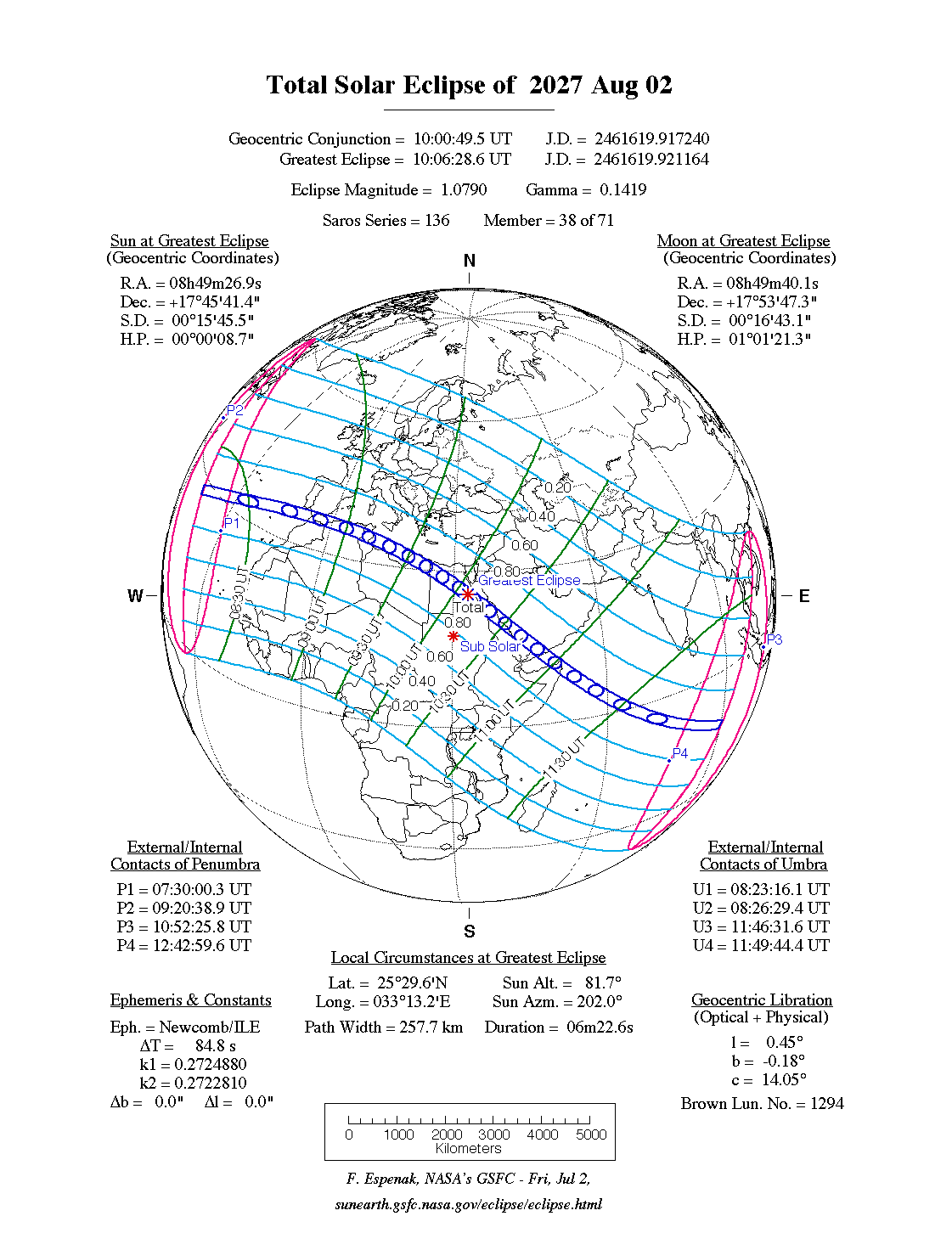
The total eclipse that day, the one with up to six minutes of darkness, happens far to the west. The track of totality crosses southern Spain, North Africa, Egypt, Saudi Arabia, Yemen and Somalia. Our calculation puts the moment of greatest eclipse at 10:06 UT, which is 3:36 pm IST, close to Luxor in Egypt, where NASA’s eclipse catalogue lists 6 minutes 23 seconds of totality.
Totality lasts so long because two distances line up. The Moon reaches perigee, its closest point to Earth, on the same day, at 357,352 km, so it looks large; the kind of closeness that makes a supermoon at full moon. And Earth passed aphelion, its farthest point from the Sun, less than a month earlier, so the Sun looks slightly small. A big Moon over a small Sun covers it for longer. Our story on how fast Earth moves explains why it travels slowest around aphelion.
What time is the solar eclipse in my city?
These are our calculated times for each city, with the share of the Sun’s disc that the Moon covers at maximum. The eclipse begins when the Moon first touches the Sun’s edge and ends when it leaves.

Why is the eclipse deeper in south India?
The Moon’s shadow has two parts. The dark core, the umbra, gives a total eclipse along a narrow track. Around it spreads the much wider penumbra, from which you see the Moon cover only part of the Sun. On 2 August 2027 the umbra’s track runs from the Atlantic across North Africa and Arabia and ends off the Horn of Africa, south-west of India. The closer a place is to that track, the deeper its eclipse. Kerala and Tamil Nadu are the nearest parts of India, so they get the most. The north-east lies beyond the edge of the penumbra.
Is this the six-minute eclipse? Not from India
Searches for a “6 minute solar eclipse in India” are understandable but mistaken. The six minutes refers to totality in Egypt. No part of India is in the Moon’s full shadow. What lasts longest in India is the partial eclipse itself: about 1 hour 51 minutes from first contact to last in Kerala, against 26 minutes in Guwahati. Daylight will hardly change. Even with half the Sun covered, the sky stays bright, and most people would not notice the eclipse at all without a proper filter.
How to watch the eclipse safely
- Use eclipse glasses or a handheld viewer made to the ISO 12312-2 standard, from a reputable seller. Check for scratches or holes before use.
- Sunglasses, smoked glass, X-ray film and stacked sunglasses are not safe. Welder’s glass is safe only at shade 14 or darker.
- Never look through binoculars, a telescope or a camera viewfinder at the Sun unless a certified solar filter covers the front of the instrument. Eclipse glasses behind binoculars do not protect you.
- Projection is the easiest safe method for a group. Sunlight through a pinhole in card, the holes of a kitchen colander or the gaps between leaves throws small crescent images on the ground.
- Supervise children throughout. The danger is the same as on any other day: looking at the bright part of the Sun causes eye damage, and a partial eclipse leaves plenty of it.
- Plan for a low Sun. In eastern India the Sun is low in the west by the end, only 1° up in Port Blair, so find an open western horizon. In early August, monsoon cloud is the biggest risk everywhere.
Sutak and grahan timings
Many Indian almanacs publish sutak and other religious timings for a surya grahan. Those follow traditional rules and are outside the scope of this article. They are built on the same astronomical contact times given above, and those times vary from city to city, so look up times for your own city rather than a single national figure.
When is the next eclipse visible from India?
The 2027 eclipse is the first of several India will see over the next decade, including an annular eclipse across the far south in 2031. Our list of every solar and lunar eclipse visible from India through 2035 has the dates and city coverage for each.
How we worked this out
We calculated the local circumstances of the eclipse for the centre of each city, at sea level, with the open-source Astronomy Engine library (version 2.1.19). The percentages are obscuration: the share of the Sun’s disc area hidden by the Moon at maximum, which is smaller than the share of the Sun’s width covered. The map uses the same calculation on a grid every quarter of a degree. Times are rounded to the minute and can differ by a minute or two from other calculations, which model the Moon’s edge slightly differently. The figure of 6 minutes 23 seconds for the longest totality is from NASA’s eclipse catalogue; our own calculation does not compute durations along the track. Coastlines come from Natural Earth.
Sources
Keep reading
More from Planets
The eclipses India will see through 2035, city by city
India’s next total lunar eclipse falls on New Year’s Eve 2028. Its next total solar eclipse arrives in 2034, close to sunset, and only the far north gets it.

The Leonids peak just before dawn on 18 November, and India has a dark sky for it
The half Moon sets around midnight, the radiant climbs high, and the predicted peak lands in the last dark hour before dawn. Here is when to look from your city, and an honest estimate of what you will see.

Which planets you can see from India this winter, and when to look
This evening only Saturn is up. The real gathering is before sunrise, when Venus, Jupiter, Mars and Mercury share the sky. By February, Jupiter and Mars move into the evening at their brightest of the season.
Comments
No comments yet. Start the conversation.